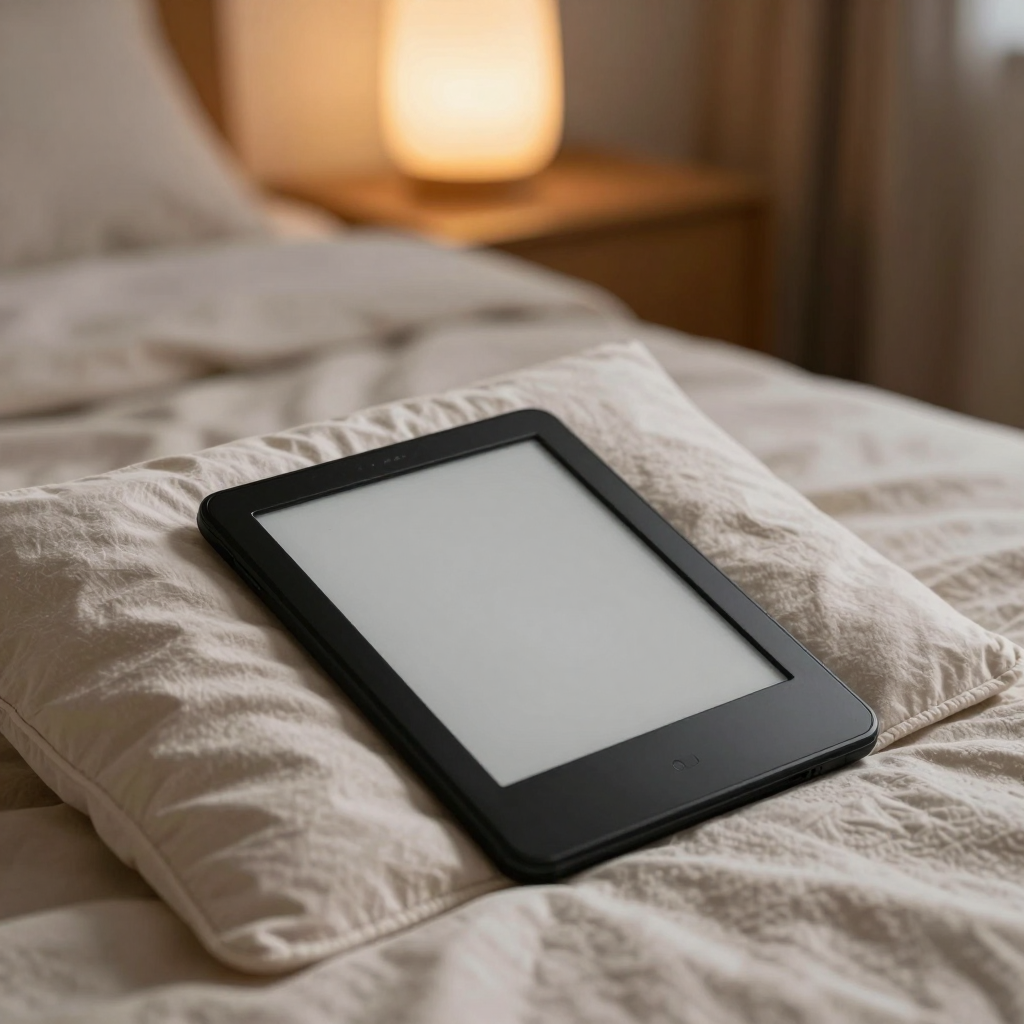
Reading Yourself to Sleep: Why a Kindle Belongs in the Bedroom
It’s 11pm, the house is quiet, and your hand reaches for the thing kept within arm’s reach of your pillow. For most of us that’s a phone. One quick check, one scroll, and suddenly you’re not choosing what you look at — the feed is choosing for you. There’s another object that belongs in that hand: a little e-ink page that only knows one job.
The back story
Reading in bed is one of the oldest wind-down rituals there is. For centuries, the last thing you did in bed was put your mind to rest with a story. Then, around 2010, the library in the pocket became a glowing rectangle that also delivered your emails, your work messages and your relatives’ holidays — and the ritual quietly broke.
The e-reader was the fix. When Amazon introduced the first Kindle in November 2007, it was a curious slab with an “electronic paper” display that read like a book and ignored everything else. Nearly two decades later, the basic idea hasn’t changed, only the execution: the 2024 Kindle weighs just 158 grams, turns pages faster than ever, and has a front light bright enough for the darkest room.
The point was never to replace paper books. It’s to give your bedroom back the one-screen-that-does-one-thing.
Why an e-ink screen suits the bedroom
- One job, no interruptions. A Kindle doesn’t do messages, email or social media. There’s nothing to answer, so there’s nothing pulling you out of the page. Amazon says it plainly: no interruptions from messages, e-mails or social media — you can lose yourself in the story.
- It reads like paper. E-ink reflects light rather than shining it at you, which is why a Kindle looks like a page in daylight and stays calm in the dark. The 2024 model’s front light is 25% brighter at maximum — the same as the pricier Paperwhite — and dark mode inverts the colours if you prefer that.
- Weeks of battery, not nights of charging. A single USB-C charge lasts up to six weeks on Amazon’s test (about half an hour of reading a day, wireless off). A wind-down ritual shouldn’t end with you hunting for a cable.
- Light enough to hold while you drift. At 158 g it’s the lightest and most compact Kindle, easy to rest against your arm or the duvet as the words start to blur.
What’s in the 2024 model
From Amazon’s product page: a 6" glare-free display at 300 ppi with 16 levels of grey; 16 GB of storage, which Amazon says holds thousands of books, plus free cloud storage; dual-band Wi-Fi; and roughly two hours to a full charge. It comes with a one-year warranty and guaranteed software security updates for at least four years. In the UK the without-ads version is around £95 (the with-ads version runs about £10 less, but remember: those ads show on the sleep screen you’ll see every night you close it, so for a bedside device the ad-free version is the one to buy). It’s available in black or the pleasantly un-pink “Matcha” colour. (We haven’t used the device ourselves — everything above is from Amazon’s product page.)
Kindle (2024, 11th generation) — Without Ads
Thousands of books, one calm
The other half of the case is the library itself. The Kindle Store gives you access to millions of titles — new releases, backlist, self-published gems — so the excuse of “there’s nothing for me” rarely survives contact with the search bar. If you’d rather not own each book, Prime Reading and Kindle Unlimited offer rotating or all-you-can-read libraries if you already subscribe.
Two honest notes on what to pick for a wind-down. First, pick something calm: an old favourite, a gentle mystery, nature writing, a book you’ve been meaning to read at half speed — not the thriller that has your heart racing by chapter three. Second, don’t worry about finishing. The whole point is the journey towards the dream, not the destination; the device remembers your page, so falling asleep mid-sentence is a feature. If you want a starting list, our best books for better sleep UK guide has picks chosen for exactly this moment.
How to build the ritual
- Same time, every night. Anchor the reading to your wind-down, not to whenever you happen to stop scrolling.
- Phone out of reach. Face down across the room is the minimum; another room is better. The Kindle replaces the scroll, so the phone loses its reason to be in the bed.
- Dim the room, light the page. Use the Kindle’s front light and keep the room lamp low — see our best bedside lamps for sleep if yours is doing the opposite.
- Pick a book that’s pleasant, not gripping. Calm pages keep you calm.
- Let the last page blur. It’s fine to doze off mid-chapter.
Is there evidence it works? Some. In one randomised online trial — the “Reading Trial” — people read in bed for a week before sleep, and 42% reported their sleep had improved, versus 28% of the control group who didn’t read. It’s a single study, not a promise, but the direction is encouraging: a quiet page is a kinder last screen than a bright feed.
An honest word
Your experience may differ — and if sleep is genuinely difficult for you, that’s a conversation for your GP, not a device.
Related reading
- Best books for better sleep UK — the starting list for your wind-down shelf.
- How to fall asleep faster — the wider wind-down toolkit.
- Best sleep mask UK — for when the lamp still leaks into your eyes.